English
 Arabic
 French
 Spanish
 Portuguese
 Deutsch
 Turkish
 Dutch
Dutch
 Italiano
 Russian
 Romaian
 Portuguese (Brazil)


Understanding Server Storage Area Network (SAN): Enhancing Data Storage Efficiency
In today’s data-driven world, businesses generate and handle an immense amount of digital information daily. Efficient storage and fast access to this data have become critical, especially for enterprises with demanding applications. One of the most powerful technologies enabling such capabilities is the Server Storage Area Network (SAN). SANs are dedicated high-speed networks that interconnect storage devices with servers, providing centralized, scalable, and highly available data storage.
Source - https://www.marketresearchfuture.com/reports/server-storage-area-network-market-5855
A Server Storage Area Network is not a typical Local Area Network (LAN). Instead, it is specifically designed to handle large-scale data transfers between storage systems and servers, bypassing the limitations of traditional network storage. This setup reduces latency, improves input/output (I/O) performance, and allows storage resources to be pooled and managed more effectively. SANs typically use Fibre Channel (FC), iSCSI (Internet Small Computer System Interface), or NVMe over Fabrics protocols for high-speed connectivity and reliability.
One of the core benefits of SAN is centralized storage management. Unlike Direct Attached Storage (DAS), where storage devices are connected directly to servers, SAN allows storage to be consolidated into a single pool, accessible by multiple servers. This not only increases storage utilization efficiency but also simplifies backup and disaster recovery processes. With SAN, IT administrators can allocate storage dynamically based on application needs, improving flexibility and resource use.
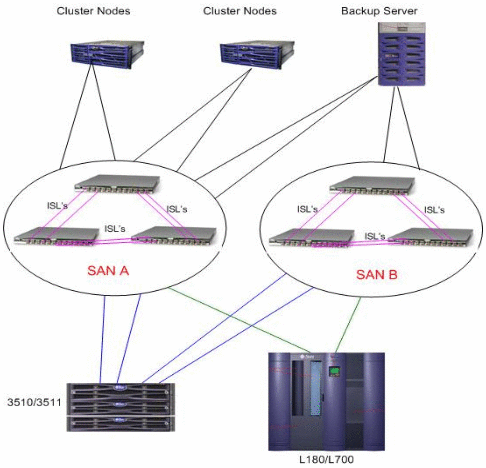
Another advantage of Server SANs is their high availability and fault tolerance. SANs are built with redundancy in mind—using multiple paths between servers and storage to ensure continuous data access even in case of hardware failure. Advanced SAN architectures support automated failover, data replication, and snapshot technologies, providing robust protection for mission-critical data. These features make SANs ideal for environments such as data centers, financial services, healthcare, and large enterprises where uptime and data integrity are non-negotiable.
Performance is a key reason organizations invest in SAN infrastructure. SANs enable fast access to storage by reducing network congestion and offloading traffic from standard LANs. This is especially important for high-performance applications like databases, virtualization platforms, and video editing, where rapid data retrieval and writing speeds are essential. With the rise of all-flash storage arrays and NVMe-based SANs, performance continues to soar, enabling real-time analytics and accelerated business operations.
However, implementing a Server Storage Area Network comes with certain challenges. The initial setup can be complex and costly, requiring specialized hardware, software, and skilled IT staff. Network design must ensure scalability, security, and minimal downtime. Despite these concerns, the long-term benefits often outweigh the costs, as SANs provide the foundation for scalable, resilient, and efficient storage environments.
Server Storage Area Networks are a cornerstone technology for modern enterprises seeking robust, high-performance, and centralized data storage solutions. As data volumes continue to grow, SANs will play a crucial role in supporting digital transformation initiatives and maintaining competitive edge through efficient and reliable data management.
In today’s data-driven world, businesses generate and handle an immense amount of digital information daily. Efficient storage and fast access to this data have become critical, especially for enterprises with demanding applications. One of the most powerful technologies enabling such capabilities is the Server Storage Area Network (SAN). SANs are dedicated high-speed networks that interconnect storage devices with servers, providing centralized, scalable, and highly available data storage.
Source - https://www.marketresearchfuture.com/reports/server-storage-area-network-market-5855
A Server Storage Area Network is not a typical Local Area Network (LAN). Instead, it is specifically designed to handle large-scale data transfers between storage systems and servers, bypassing the limitations of traditional network storage. This setup reduces latency, improves input/output (I/O) performance, and allows storage resources to be pooled and managed more effectively. SANs typically use Fibre Channel (FC), iSCSI (Internet Small Computer System Interface), or NVMe over Fabrics protocols for high-speed connectivity and reliability.
One of the core benefits of SAN is centralized storage management. Unlike Direct Attached Storage (DAS), where storage devices are connected directly to servers, SAN allows storage to be consolidated into a single pool, accessible by multiple servers. This not only increases storage utilization efficiency but also simplifies backup and disaster recovery processes. With SAN, IT administrators can allocate storage dynamically based on application needs, improving flexibility and resource use.
Another advantage of Server SANs is their high availability and fault tolerance. SANs are built with redundancy in mind—using multiple paths between servers and storage to ensure continuous data access even in case of hardware failure. Advanced SAN architectures support automated failover, data replication, and snapshot technologies, providing robust protection for mission-critical data. These features make SANs ideal for environments such as data centers, financial services, healthcare, and large enterprises where uptime and data integrity are non-negotiable.
Performance is a key reason organizations invest in SAN infrastructure. SANs enable fast access to storage by reducing network congestion and offloading traffic from standard LANs. This is especially important for high-performance applications like databases, virtualization platforms, and video editing, where rapid data retrieval and writing speeds are essential. With the rise of all-flash storage arrays and NVMe-based SANs, performance continues to soar, enabling real-time analytics and accelerated business operations.
However, implementing a Server Storage Area Network comes with certain challenges. The initial setup can be complex and costly, requiring specialized hardware, software, and skilled IT staff. Network design must ensure scalability, security, and minimal downtime. Despite these concerns, the long-term benefits often outweigh the costs, as SANs provide the foundation for scalable, resilient, and efficient storage environments.
Server Storage Area Networks are a cornerstone technology for modern enterprises seeking robust, high-performance, and centralized data storage solutions. As data volumes continue to grow, SANs will play a crucial role in supporting digital transformation initiatives and maintaining competitive edge through efficient and reliable data management.
Understanding Server Storage Area Network (SAN): Enhancing Data Storage Efficiency
In today’s data-driven world, businesses generate and handle an immense amount of digital information daily. Efficient storage and fast access to this data have become critical, especially for enterprises with demanding applications. One of the most powerful technologies enabling such capabilities is the Server Storage Area Network (SAN). SANs are dedicated high-speed networks that interconnect storage devices with servers, providing centralized, scalable, and highly available data storage.
Source - https://www.marketresearchfuture.com/reports/server-storage-area-network-market-5855
A Server Storage Area Network is not a typical Local Area Network (LAN). Instead, it is specifically designed to handle large-scale data transfers between storage systems and servers, bypassing the limitations of traditional network storage. This setup reduces latency, improves input/output (I/O) performance, and allows storage resources to be pooled and managed more effectively. SANs typically use Fibre Channel (FC), iSCSI (Internet Small Computer System Interface), or NVMe over Fabrics protocols for high-speed connectivity and reliability.
One of the core benefits of SAN is centralized storage management. Unlike Direct Attached Storage (DAS), where storage devices are connected directly to servers, SAN allows storage to be consolidated into a single pool, accessible by multiple servers. This not only increases storage utilization efficiency but also simplifies backup and disaster recovery processes. With SAN, IT administrators can allocate storage dynamically based on application needs, improving flexibility and resource use.
Another advantage of Server SANs is their high availability and fault tolerance. SANs are built with redundancy in mind—using multiple paths between servers and storage to ensure continuous data access even in case of hardware failure. Advanced SAN architectures support automated failover, data replication, and snapshot technologies, providing robust protection for mission-critical data. These features make SANs ideal for environments such as data centers, financial services, healthcare, and large enterprises where uptime and data integrity are non-negotiable.
Performance is a key reason organizations invest in SAN infrastructure. SANs enable fast access to storage by reducing network congestion and offloading traffic from standard LANs. This is especially important for high-performance applications like databases, virtualization platforms, and video editing, where rapid data retrieval and writing speeds are essential. With the rise of all-flash storage arrays and NVMe-based SANs, performance continues to soar, enabling real-time analytics and accelerated business operations.
However, implementing a Server Storage Area Network comes with certain challenges. The initial setup can be complex and costly, requiring specialized hardware, software, and skilled IT staff. Network design must ensure scalability, security, and minimal downtime. Despite these concerns, the long-term benefits often outweigh the costs, as SANs provide the foundation for scalable, resilient, and efficient storage environments.
Server Storage Area Networks are a cornerstone technology for modern enterprises seeking robust, high-performance, and centralized data storage solutions. As data volumes continue to grow, SANs will play a crucial role in supporting digital transformation initiatives and maintaining competitive edge through efficient and reliable data management.
·528 Visualizações